
 English
 Español
Submit feedback

How Does Rear Bumper Geometry Stay Consistent
Rear bumper systems belong to the most geometrically demanding exterior components in modern vehicles. Large span, deep curvature, integrated sensor zones, and styling cut lines create a structure that is highly sensitive to shrinkage, cooling imbalance, and tooling precision. Even small instability inside production can appear later as visible distortion, uneven gaps, or misalignment with tail lamps and quarter panels.
The stability of a car rear bumper mold determines how reliably molten polymer transforms into a repeatable three-dimensional shape. Because bumper covers are thin-walled and visually exposed, geometry consistency depends on a tightly controlled interaction between mold structure, material flow, and thermal management.
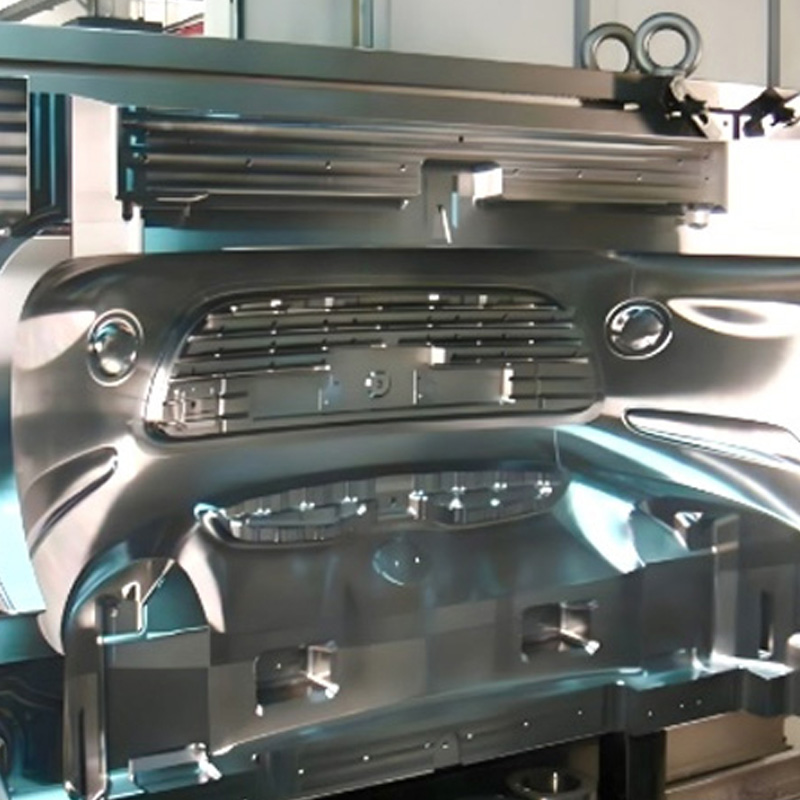
Large-Scale Geometry Requires Structural Stability from the Mold
Rear bumpers are typically classified as Class A exterior surfaces. These surfaces demand high visual continuity across wide spans, often exceeding 1.5 meters in length. Structural complexity increases further due to mounting brackets, parking sensor openings, and reinforcement ribs.
Industry analysis of bumper tooling shows that molds must integrate multiple systems such as lateral core pulling, external parting lines, and sequential valve gating to handle undercuts and complex release behavior.
Key structural requirements include:
- Stable cavity rigidity across long mold spans
- Controlled deformation resistance under injection pressure
- Accurate parting line definition for surface continuity
- Consistent ejector force distribution
Without stable tooling architecture, large panels tend to show uneven cooling shrinkage, which directly impacts final geometry consistency.
Material Flow Behavior Shapes Final Geometry
Molten polymer entering the cavity does not behave uniformly across a large bumper structure. Flow hesitation, pressure drop, and temperature gradients influence how molecules orient and solidify.
Rear bumpers commonly use PP-based compounds or reinforced thermoplastics. These materials show shrinkage behavior influenced by fiber orientation and cooling rate differences.
- PP + EPDM blends provide flexibility and impact resistance
- Talc-filled PP improves stiffness and dimensional stability
- PC/ABS blends improve surface quality and heat resistance
According to bumper molding defect studies, uneven wall thickness combined with cooling variation creates localized shrinkage differences that distort final geometry.
These variations often appear in:
- Corner curvature near wheel arch transitions
- Sensor mounting zones
- Central license plate recess area
Cooling System Balance Controls Warpage Behavior
Thermal management inside the mold directly affects dimensional stability. Cooling channels distribute temperature across the cavity, guiding how the part solidifies from a molten state to a rigid structure.
Simulation studies of bumper molds show that optimized cooling layouts reduce warpage and curling deformation significantly by balancing temperature gradients across large surfaces.
Important cooling design factors include:
- Uniform channel spacing across long cavity sections
- Localized cooling near thick rib structures
- Temperature symmetry between left and right mold halves
Cooling imbalance may result in:
- Upward or downward warping of bumper edges
- Twisting near mounting points
- Subtle mismatch between opposite sides of the bumper
These distortions accumulate during cooling and remain locked into the final geometry after ejection.
Gate System Design and Sequential Filling Control
Injection gate location and type define how molten material enters the cavity. Rear bumper molds often use hot runner systems with sequential valve control to manage flow balance across complex geometry.
Advanced designs integrate multiple gate points to control filling order and reduce weld line formation across visible surfaces.
Common gate-related influences on geometry stability include:
- Pressure distribution consistency during filling phase
- Reduction of premature freezing in long flow paths
- Balanced packing pressure across cavity zones
Improper gating strategy may cause localized density variation, which later appears as dimensional inconsistency or slight surface deformation.
Dimensional Tolerance Control in Large Bumper Parts
Rear bumpers operate under tight tolerance windows due to their direct interface with multiple surrounding components. Even minor deviations affect gap uniformity and visual alignment.
Typical dimensional tolerance ranges for bumper systems fall within approximately ±0.5 mm to ±1.2 mm depending on functional zone requirements. :contentReference[oaicite:4]{index=4}
Critical tolerance-sensitive regions include:
- Tail lamp interface edges
- Trunk closure alignment zones
- Side connection points with quarter panels
Even small deviations in these areas become visible as uneven panel gaps or flushness variation after assembly.
Material Shrinkage Compensation Inside Mold Design
Every polymer grade exhibits a specific shrinkage range after cooling. Mold cavity dimensions must compensate for this behavior to ensure correct final geometry.
Typical shrinkage ranges include:
- PP-based materials: approximately 1.0%–2.0%
- PC/ABS blends: approximately 0.5%–0.8%
- Mineral-filled compounds: approximately 0.3%–1.0%
Non-uniform shrinkage across thick and thin regions produces internal stress gradients, which influence final bumper curvature and fit consistency.
Structural Reinforcement and Geometry Retention
Rear bumpers integrate internal ribs, mounting bosses, and reinforcement beams that improve crash performance and installation stability. These features also affect how the part retains geometry after cooling.
- Rib distribution increases stiffness across wide spans
- Boss reinforcement stabilizes mounting load transfer
- Curvature control zones reduce deformation in visible areas
Balanced structural design reduces internal stress concentration, helping the bumper maintain consistent geometry across production cycles.
Assembly as a Verification Stage, Not a Correction Stage
Vehicle assembly aligns bumper covers with adjacent body panels using clips, bolts, and guided fixtures. However, assembly cannot fully correct geometric distortion already locked into molded parts.
Common observable issues during assembly include:
- Uneven spacing between bumper and tail lamp edges
- Corner lift near wheel arch transitions
- Minor twist along long horizontal sections
- Fit variation across production batches
Such conditions often reflect upstream molding behavior rather than installation error, reinforcing the importance of stable tooling design.
Geometry consistency in rear bumper systems is not maintained by assembly alone. It is established through a combination of mold rigidity, flow control strategy, thermal balance, and shrinkage compensation design.
The car rear bumper mold acts as the foundation of dimensional accuracy. Once cooling channels, gating systems, and structural reinforcement are properly balanced, the molded part retains stable geometry across production cycles, allowing consistent fitment with surrounding body panels and reducing visible variation in final vehicle appearance.



The company focuses on the field of special equipment manufacturing, and its core business revolves around the design, manufacturing and related technical services of injection molds.
© Taizhou Lingfei Mould & Plastic Technology Co., Ltd.
OEM Injection Mold Factory
